Delegation is a To-Do List. P&L at the Edge is a Belief System
February 17, 2026
Information Is Cheap. Decisions Are the Differentiator.
March 3, 2026
Organizations are trapped in this catch-22 of continuous transformation, trying to find new and creative ways to maximize their cost:return ratio per worker. In our forthcoming book HumanCorps, Andrew and I don’t present this as a moral failing but rather as an inherited operating logic — Industrial-Age thinking wearing digital clothing.
But it may as well be a wolf in sheep’s clothing.
Because once “cost:return per worker” becomes the core lens, transformation becomes a loop:
- squeeze cost,
- raise output,
- automate tasks,
- reorganize,
- announce a new operating model,
- and repeat.
It looks like progress. It often feels like motion. But the catch-22 is that the very methods used to extract more “return” per person can quietly destroy the conditions that produce real return in the first place: agency, judgment, learning, psychological safety, and trust.
The Gap That Keeps Reappearing
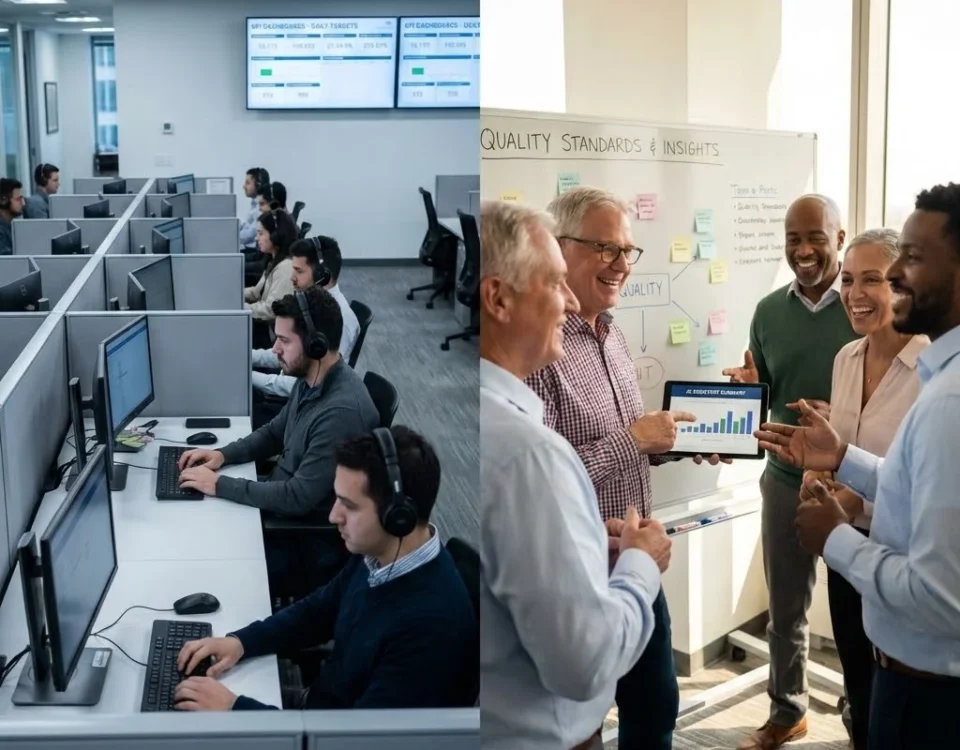
You’ve been there. A transformation program kicks off with bold language: agility, customer centricity, AI enablement. The slide deck promises efficiency and growth. The glossy photos and the slick story. Then new metrics land. New tools arrive. New reporting cycles begin.
Followed by the same patterns reasserting themselves.
Andrew and I argue in HumanCorps that this happens because many transformations focus on the formal system (i.e., structures, processes, targets, platforms) while underinvesting in the informal system (i.e., beliefs, relationships, sensemaking, motivation, and the lived experience of work). The organization changes its chart, not its nervous system.
So the “solution” becomes yet another transformation.
That’s the treadmill: when the system’s default response to complexity is to intensify control and measurement, it can generate short-term efficiency while steadily lowering adaptability. The organization becomes more optimized and less wise.
Why the Cost: Return Lens Shrinks the Human
In HumanCorps, the shift from Industrial Age to the Knowledge Age (which began in the early 1990s) and the newly emerging Wisdom Age is a shift in what creates value.
Industrial Age logic treats humans as predictable components in a machine: if you standardize work, measure it tightly, and reduce variance, you can increase output.
Andrew and I argue in HumanCorps that modern value is increasingly created through wisdom work: judgment, ethics, creativity, contextual reasoning, and collaboration in ambiguity. That kind of value doesn’t scale through tighter scripts. It scales through better conditions for human cognition and collective intelligence.
Here’s the catch-22:
- If you treat people primarily as costs to be optimized, you will build systems that reduce discretion.
- If you reduce discretion, you reduce ownership.
- If you reduce ownership, you reduce learning and local problem-solving.
- If you reduce learning, you must transform again to keep up.
The organization becomes dependent on periodic “change events” instead of continuous, distributed adaptation. We all love it when our machines or our browsers need to be rebooted. And we are applying this sort of reboot logic on numbers of humans within the organization.
Neuroscience: The Brain Under Transformation Fatigue
Many frame our competitive landscape as being one in high-disruption, often described through BANI conditions (brittle, anxious, non-linear, incomprehensible). In such contexts, chronic transformation pressure can place workers into sustained uncertainty: shifting priorities, role ambiguity, constant evaluation.
Neuroscience helps explain why that environment degrades performance.
Chronic stress impairs prefrontal cortex functions (e.g., working memory, cognitive flexibility, inhibition, planning) especially under conditions of perceived uncontrollability (Arnsten, 2009). When employees feel they are constantly being “restructured at,” their nervous system shifts toward threat vigilance, narrowing attention and encouraging short-term, self-protective behavior.
Over time, stress-related neuroplastic changes can reduce prefrontal effectiveness and increase reliance on habitual responses, making complex learning and adaptation harder (McEwen & Morrison, 2013). In plain terms: the more you run transformation as pressure and surveillance, the more you biologically suppress the exact capabilities you say you want: initiative, creativity, collaboration.
And motivation isn’t immune.
Self-determination theory shows that autonomy, competence, and relatedness are core psychological needs that drive intrinsic motivation and internalization of goals (Deci & Ryan, 2000). A transformation agenda that maximizes cost:return by tightening control often harms autonomy (more approvals), competence (less time to learn), and relatedness (more competition and silo behavior). The result is compliance without commitment: activity without ownership.
That’s why organizations can “transform” endlessly and still feel stuck.
The Measurement Trap: What You Count Becomes What You Can Imagine
Since the rise of Taylor’s scientific management roughly around the time as the first MBA degrees from business schools, organizations have gravitated toward what they can measure. Cost:return per worker is alluring because it is crisp. It is reportable. It feels like certainty.
But when that ratio becomes the dominant story, leaders begin to manage what is visible (utilization, throughput, headcount) and ignore what is decisive but less visible (trust, sensemaking quality, psychological safety, coordination costs).
In complex systems, the invisible is often causal.
So the organization keeps paying for new systems, new consultants, new operating models, because the metrics keep saying “we must.” And because the deeper levers — beliefs about control, assumptions about people, decision rights, accountability design — are emotionally harder than procurement.
The Countermove in HumanCorps: From Optimization to Sapience
Andrew and I argue in HumanCorps that the core upgrade is not a new org chart. It’s a new relationship with complexity.
Instead of treating transformation as episodic and top-down, the book leans toward building human-synthetic organizations where AI augments sensemaking and coordination while accountability remains human.
The goal shifts from extracting more output per worker to increasing sapience: the organization’s capacity to derive shared meaning from experience and act coherently.
That shift requires design choices:
- Decision rights pushed toward the edge. People closest to the work need authority to adapt, not just instructions to execute.
- Risk envelopes and clear constraints. Autonomy without boundaries becomes chaos; boundaries without autonomy become bureaucracy.
- Collective intelligence practices. Diverse perspectives, constructive tension, and collaboration that improves judgement.
- Psychological safety and brave space. The ability to surface problems early, admit uncertainty, and learn fast.
- AI as augmentation, not acceleration of Taylorism. If technology only speeds up old control systems, you get faster brittleness.
This is how you escape the catch-22: you stop trying to “transform” your way into adaptability and instead build adaptability as a property of the system.
The Performance Payoff: When Return Comes from Capability, Not Extraction
When organizations invest primarily in maximizing cost:return per worker, they may win short-term efficiency while losing long-term resilience.
HumanCorps’ wager is different: durable return comes from upgrading human capability and collective accountability, so the system can respond to non-linear change without requiring constant reinvention from above.
That doesn’t mean ignoring economics. It means recognizing that in the Wisdom Age, the biggest returns often come from the human layer: better decisions, faster learning, higher trust, and less friction.
The irony is that the most financially disciplined move may be to stop treating humans as a ratio.
Questions That Reveal Whether You’re on the Treadmill
- Are your transformations primarily reorganizations and tools, or are they changes in decision rights and accountability?
- Do your metrics reward local learning and customer outcomes, or only utilization and cost?
- When something fails, do you ask “who missed the KPI?” or “what did the system make inevitable?”
- If AI arrived tomorrow with perfect analytics, would your organization have the trust and agency to act on them?
Because the trap isn’t transformation itself.
It’s transformation that keeps optimizing the machine while starving the humans.
Works referenced
- Arnsten, AFT. 2009. Stress signalling pathways that impair prefrontal cortex structure and function. Nature Reviews Neuroscience 10.6.410-22. https://www.nature.com/articles/nrn2648
- Deci, EL, & Ryan, RM. 2000. The “what” and “why” of goal pursuits: Human needs and the self-determination of behavior. Psychological Inquiry 11.4.227-68. https://www.tandfonline.com/doi/abs/10.1207/S15327965Pli1104_01
- McEwen, BS, & Morrison, JH. 2013. The brain on stress: Vulnerability and plasticity of the prefrontal cortex over the life course. Neuron 79.1.16-29. https://www.cell.com/neuron/fulltext/S0896-6273(13)00544-8